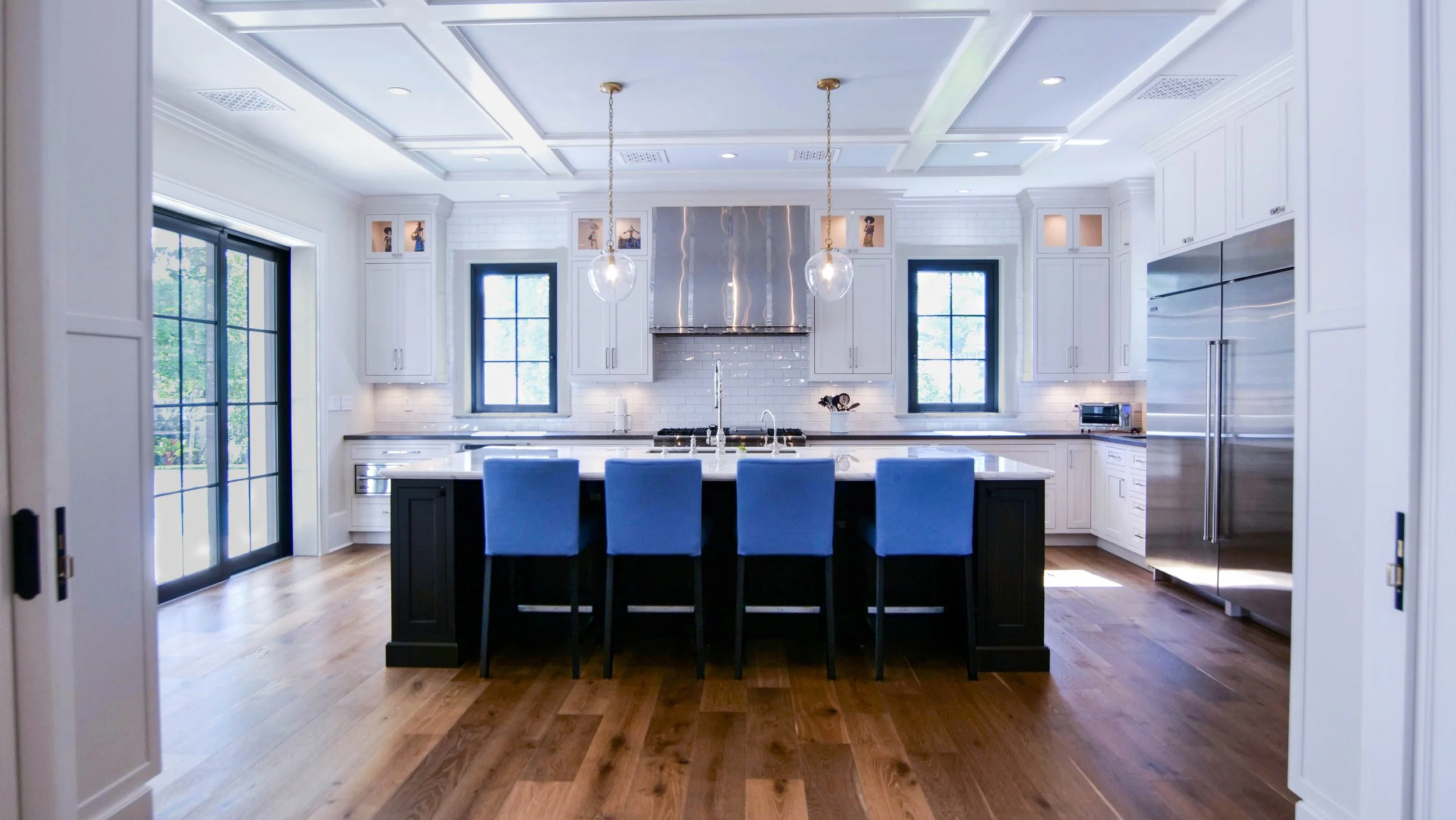
1. How much does a kitchen remodel cost? Kitchen remodeling costs typically range from $20,000 to $100,000, depending on the size of the space, the scope of the project, and the materials and finishes selected. Our AI-powered estimating tool allows clients to upload one photo of their existing kitchen and receive a personalized remodeling estimate within seconds, including an itemized breakdown of each trade involved: https://www.eleetcabinetry.com/quick-price
2. How much should I budget for new kitchen cabinets? For a kitchen remodel, cabinetry typically represents about 40% of the total project budget. For a new custom home, cabinetry may account for approximately 5% of the home’s overall construction cost. This includes all cabinetry and built-ins throughout the home, including the kitchen, bathrooms, laundry room, media room, office, and other custom spaces.
3. What is the most expensive part of a kitchen remodel? Cabinetry is typically the largest expense in a kitchen remodel. Clearly communicating your budget and remaining flexible with design and material selections allows an experienced designer to create a kitchen that meets your needs without exceeding your budget.
4. How can I estimate the cost of remodeling my kitchen? Our AI-powered estimating tool allows clients to upload one photo of their existing kitchen and receive a personalized remodeling estimate within seconds, including an itemized breakdown of the costs associated with each trade: https://www.eleetcabinetry.com/quick-price
5. What unexpected costs should I prepare for? Prepare for unexpected costs caused by conditions that were not confirmed before the remodel began. These may include discovering a load-bearing wall, outdated electrical wiring, hidden plumbing problems, water damage, uneven floors, or incorrect site measurements. Confirm as many details as possible before ordering cabinetry
6. Does a kitchen remodel increase a home’s value? As a general guideline, investing 5% to 15% of your home’s value in a kitchen remodel can provide the strongest potential return on investment.
7. Which kitchen upgrades provide the best return on investment? Your remodeling priorities should be based on the condition and functionality of the existing kitchen. Dated or damaged cabinetry may need to be replaced first. However, if the cabinets are in excellent condition, updating the countertops or appliances may provide a greater improvement without requiring a complete renovation.
8. Is custom cabinetry worth the extra cost? Yes, custom cabinetry can be worth the additional cost because it is designed specifically for your space, storage needs, preferred features, and style. It also does not have to exceed your budget. By clearly communicating your budget and priorities, a skilled kitchen designer can recommend the right layout, materials, finishes, and construction specifications to give you the greatest value for your investment.
9. Should I remodel my entire kitchen at once? In most cases, remodeling the entire kitchen at once is more efficient and cost-effective. Completing the project in separate phases can result in repeated overhead, labor, delivery, and project management costs. A single, coordinated remodel distributes those expenses across the full project while reducing delays and disruptions.
10. How can I remodel a kitchen without overspending? The best way to avoid overspending is to establish a realistic budget and communicate it clearly to your kitchen designer from the beginning. You should also remain flexible about layouts, materials, finishes, and features. An experienced designer can identify where to invest, where to simplify, and how to achieve your goals without exceeding your budget.
11. Should I hire a kitchen designer? Working with a qualified kitchen designer is highly recommended, particularly when the designer is part of your cabinetry company. Because every cabinet manufacturer prices materials, finishes, modifications, and construction features differently, an in-house designer can make informed recommendations that align your desired design goals.
12. Do I need a general contractor for a kitchen remodel? It depends on your experience, availability, and the complexity of the remodel. Managing the project yourself can save money, but it requires coordinating trades, materials, schedules, inspections, and job-site issues. A general contractor can handle these responsibilities and keep the project organized.
13. What should I prioritize when planning my kitchen? Focus on the layout and cabinetry finishes. Think of the layout as the composition of a piece of art. It establishes balance, proportion, and flow throughout the space. The cabinetry finish brings that composition to life through its color, texture, depth, and craftsmanship. Together, these elements turn a functional kitchen into a thoughtfully designed work of art.
14. How far in advance should I start planning? Your planning timeline should reflect the project’s complexity. A simple kitchen remodel with no structural changes may require 1 to 2 months of planning. A project involving wall removal or layout changes should begin 3 to 6 months in advance, allowing sufficient time to evaluate design options and verify structural conditions before finalizing the plans.
15. How long does a complete kitchen remodel take? The design phase varies based on the complexity of the project and the client’s decision-making timeline. After the design is approved and the order enters production, custom cabinetry typically requires 4 to 8 weeks to manufacture and approximately one week to install. Countertops generally require an additional two weeks, followed by 1 to 2 weeks for final installations and finishing work.
16. Can I remain in my home during the remodel? Yes, homeowners can generally remain in the house during a kitchen-only remodel. The construction area should be separated from the living space with protective plastic barriers to control dust and debris. A temporary kitchen should also be established with access to water, refrigeration, and a safe method of preparing meals.
17. How long will I be without a functioning kitchen? for a simple remodel the average is 1 to 2 months
18. What decisions need to be made before ordering cabinets? All assumptions, measurements, selections, and construction details must be verified before cabinetry is ordered. Once the order is released into production, changes may be impossible or result in significant additional costs and delays. A thorough final review helps ensure the cabinetry is built correctly for the approved design.
19. What is the difference between stock, semi-custom, and custom cabinets? Stock cabinets are manufactured in standard sizes with a limited selection of door styles, colors, and finishes. Semi-custom cabinetry provides more flexibility but remains limited to the manufacturer’s available options. Full-custom cabinetry allows dimensions, construction details, finishes, and features to be tailored to the project, including custom paint and stain matching, provided the design is technically feasible.
20. What makes one cabinet higher quality than another? The finish is one of the most difficult elements of cabinetry to perfect. When compared side by side, the difference is immediately noticeable. Lower-quality finishes may appear uneven, thin, or poorly applied, while luxury finishes provide greater depth, consistency, smoothness, and visual richness.
21. How long should quality kitchen cabinets last? When properly maintained, high-quality cabinetry should last a lifetime. At Eleet Fine American Cabinetry, we stand behind the quality of our products by offering a lifetime warranty on all our cabinetry. https://www.eleetcabinetry.com/our-product
22. What are the best materials for kitchen cabinets? There is no single material that is best for every cabinetry project. The right choice depends on the desired appearance, intended application, durability requirements, and available budget. Each material should be selected based on how well it supports the overall design.
23. Are solid-wood cabinets better than plywood cabinets? Cabinetry is rarely made entirely from solid wood. Cabinet boxes are typically constructed from either furniture board or plywood, while doors may be made from furniture board, plywood with a wood veneer, or solid wood. Solid-wood doors are durable, have consistent color throughout the material, and can provide exceptional depth and richness in the finish. Plywood doors with a wood veneer can also be beautiful and durable, with the added advantage of greater dimensional stability as humidity changes. Because solid wood naturally expands and contracts, our solid-wood door options require slightly larger reveals, which are the spaces between the doors.
24. What is furniture-grade plywood? Furniture-grade plywood is a high-quality plywood manufactured to be exceptionally straight, strong, and dimensionally stable. It typically contains more plies than standard plywood, helping it resist warping and maintain its shape over time.
25. What does American-made cabinetry mean? American-made cabinetry means the wood components are milled and the cabinetry is manufactured and assembled in the United States. However, certain components, such as hinges and drawer glides, may be sourced internationally. Eleet Fine American Cabinetry manufactures its cabinetry in the United States and on our state line Blum hinges and drawer glides, which are engineered by a leading German hardware manufacturer.
26. Are custom cabinets built specifically for my kitchen? Yes. Custom cabinets are designed and built specifically for your kitchen’s measurements, layout, architectural details, storage needs, and desired appearance. Unlike stock cabinetry, custom cabinets are not limited to standard sizes, allowing them to maximize the available space and create a more integrated design.
27. What is the difference between framed and frameless cabinets? Framed cabinetry has a 1½-inch solid-wood face frame attached to the front of each cabinet box. Frameless cabinetry, often called European-style cabinetry, does not have a face frame and consists of a furniture-board or plywood box. 32. Framed construction is commonly selected for inset cabinetry, where the doors and drawer fronts sit inside the face frame. Frameless cabinetry provides more usable interior space and allows for wider drawers within the same overall cabinet dimensions. Unless you specifically want the appearance of inset cabinetry, we generally recommend frameless construction. Eleet Fine American Cabinetry can build either option.
28. What are inset cabinets? Inset cabinetry features doors and drawer fronts that fit precisely within a 1½-inch solid-wood face frame. This construction demands extremely tight tolerances because every component must align perfectly with its opening. The cabinet must remain square and stable to ensure consistent spacing, smooth operation, and proper alignment. Because inset cabinetry leaves little room for error, it should be produced by an experienced manufacturer with proven capabilities. Eleet’s portfolio of estate homes reflects our experience and precision in manufacturing high-quality inset cabinetry.
29. Are inset cabinets better than overlay cabinets? Neither inset nor overlay cabinetry is inherently better. The difference is primarily aesthetic. Inset cabinetry provides a traditional, handcrafted appearance associated with homes built before the 1950s, while overlay cabinetry typically creates a more streamlined look.
30. What is full-overlay cabinetry? Full-overlay cabinetry features doors and drawer fronts that cover nearly the entire front of the cabinet. Minimal spacing is maintained between each component to allow proper operation, creating a clean and continuous appearance.
31. What are face-frame cabinets? Framed cabinetry has a 1½-inch solid-wood face frame attached to the front of each cabinet box.
32. What cabinet construction details should I look for? Quality cabinetry should feature a smooth and consistent finish, precise door and drawer-front alignment, durable dovetail drawer construction, and premium under mount glides. Consistent spacing and smooth operation also demonstrate careful manufacturing and installation.
33. Are dovetail drawers important? Yes. Dovetail joints improve drawer-box strength and durability while providing a clean, high-quality appearance. They are a traditional sign of careful craftsmanship and well-built cabinetry.
34. What are soft-close doors and drawers? Soft-close hardware controls the final portion of a door or drawer’s movement, allowing it to close smoothly and quietly. This feature improves the user experience while helping protect the cabinet, hardware, and contents from repeated impact.
35. Are soft-close hinges worth the additional cost? Yes. Soft-close hinges are worth the additional cost because they prevent doors from slamming, reduce noise, and limit unnecessary wear on the cabinetry. They also provide a smoother, more refined experience every time the cabinets are used.
36. What is a full-extension drawer slide? A full-extension drawer slide allows the drawer to extend completely beyond the front of the cabinet. This provides easy access to the entire drawer, including items stored at the very back.
37. How much weight can cabinet drawers hold? Eleet’s standard cabinet drawer glides are rated to support up to 100 pounds, which is more than sufficient for most household storage needs. Heavy-duty options are available for specialized applications, although most clients do not require them.
38. What cabinet style is best for my home? The best cabinet style is the one that reflects your personal taste and complements your home. We recommend showing your kitchen designer 10 to 15 photos of kitchens you like. Your designer can then identify the recurring
39. What are the most timeless cabinet styles? Shaker cabinetry is one of the most timeless cabinet styles. Its simple frame-and-panel design works well in traditional, transitional, and contemporary kitchens, allowing it to remain relevant as other design elements change over time.
40. Are Shaker cabinets going out of style? No. Shaker cabinetry is not going out of style. Eleet Fine American Cabinetry has been in business for more than 25 years, and Shaker doors have represented a significant portion of the cabinetry market throughout that entire time. Their simple, balanced design allows them to work in traditional, transitional, and contemporary homes.
41. Should cabinets extend all the way to the ceiling? Not necessarily. Whether cabinetry should extend to the ceiling depends on the room’s size, proportions, ceiling height, design goals, and budget. In a smaller home, tall cabinetry can overwhelm the space and make it feel crowded. Limiting cabinet height is also one of the easiest ways to control costs. Homeowners often underestimate the expense of extending cabinetry to the ceiling because the upper portion requires additional cabinets, finished materials, moldings, and installation. With ceilings higher than eight feet, oversized plywood and longer wood components may also be required, further increasing the price.
42. Should upper and lower cabinets be the same color? Using the same color for upper and lower cabinets is generally the safest and most cohesive option. In certain designs, contrasting upper and lower cabinets on the same wall can create a distinctive look, but it must be carefully balanced. A more common approach is to use one color for the perimeter cabinetry and a contrasting color for the kitchen island.
43. Are two-tone kitchens still popular? Yes. Two-tone kitchens remain popular, especially when the island is finished in a contrasting color from the perimeter cabinetry. This creates a focal point while keeping the overall design balanced and cohesive.
44. What cabinet colors make a kitchen look larger? Light-colored cabinetry, such as white, cream, or light gray, reflects more light and can make a kitchen feel larger and more open. If you prefer darker cabinets, pairing them with white or light-colored countertops can brighten the space and create a similar sense of openness.
45. Are white kitchen cabinets still popular? Yes. White kitchen cabinets remain popular and represent close to 30% of the market. However, design trends are shifting toward quarter-sawn white oak cabinetry in natural, warm finishes.